
-V.M.Murali
Govind K. Saji, a young filmmaker from Kerala, has produced a short film aimed at drawing global attention to the injustices inherent in the 'Kafala' labor contract system prevalent in the Middle East. Here is an introduction review to the film.
The labor contract system practiced in Middle Eastern countries, especially in the Gulf nations, is called ‘Kafala’. Governments in those countries permit people to bring in workers from abroad to work in the homes and companies of the wealthy there. The person who brings them becomes the legal guardian (Kafeel) of the worker coming from abroad.
When the monarchies of the Gulf began to flourish due to oil wealth in the 1970s, the physical labor of foreign workers was needed for the development of their infrastructure. At that time, the ‘Kafala’ system, which had already been followed in that region for a thousand years, gained momentum. When local workers were insufficient, workers were brought from foreign countries on a contract basis.
Rules regarding ‘Kafala’ are outlined in the sacred book of Islam. It also explains the rights of those who are employed in this manner. However, when it comes to actual practice, all those rules become worthless. Among those affected by the ‘Kafala’ system at the hands of Arabs are not only followers of other religions but also Muslims.
The sense of dominance among employers, along with the fact that the laws of the working countries favor the locals, creates an environment lacking moral awareness and turns into tear-jerking stories of workers. The misery of becoming bonded slaves to Arab employers who invite them with the promise of work continues even in the 21st century.
From all over the world—especially from African and South Asian countries—hundreds of thousands of male and female workers work in Gulf countries (Saudi Arabia, Bahrain, Kuwait, Qatar, Oman, and the United Arab Emirates) as contract laborers. About 30% of them are women. This system also exists in Jordan and Lebanon. In Israel, where this system had been practiced, it was abolished by the country’s court in 2006.
Most of these workers are taken to those countries by middlemen who lure them with promises of good jobs and good salaries. A large number of them realize only after reaching there that they are treated like slaves. But they get trapped in a vicious circle from which they cannot escape.
Governments that have modified the ‘Kafala’ contract system according to their convenience grant maximum authority (including visa arrangements) to the employer. Because of this, some employers confiscate the worker’s passport and treat them like bonded laborers. The worker cannot leave them and move to another job; cannot live in a healthy environment at the workplace; and even if they decide they do not want the job, they cannot leave the country.
Although global awareness has arisen and condemnations have been voiced regarding this issue, this contract labor system still continues in some Arab countries even today.
In 2020, when a young woman from the Philippines, Jeanelyn Villavende, who had gone as a ‘khadima’ (domestic worker), was sexually assaulted and killed by her employer in Kuwait, strong condemnations arose around the world. When Sumi Akter from Bangladesh (2019), who was injured after her employer poured boiling oil on her, and Kasturi Munirathinam from Tamil Nadu of India (2015), who lost her right hand after jumping from a building to escape her employer’s cruelty, returned from Saudi Arabia, the world realized the brutality of the ‘Kafala’ system.
Saudi Arabia has announced that a new law will be introduced from June 2025 in place of this system. Some reforms have been made in Qatar. In 2009, Bahrain attempted to reform this contract system. Nevertheless, this cruel contract system still continues in some countries.

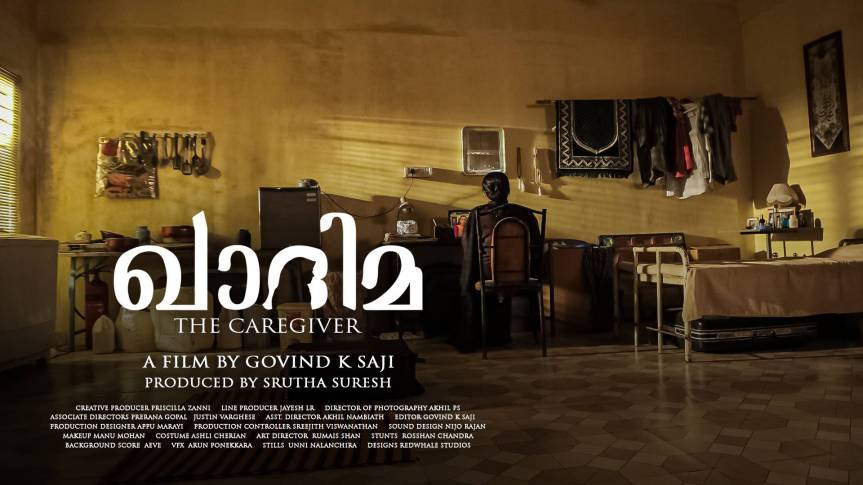
To raise awareness about this issue, a young man from Kerala, Govind K. Saji, has made a wonderful short film titled “Khadima: The Caregiver”. In Arab countries, the practice of hiring female workers from abroad on a contractual basis for a specific period to care for children and the elderly—as caregivers (Khadima)—also falls under the kafala system.
This 14:18-minute Malayalam short film has attracted global attention and has also won several national and international awards for Govind K. Saji.
Janaki travels from a beautiful village in Kerala to Saudi Arabia to work as a maid. Her son, Achu (in the film: Anay Krishnalal), is a special-needs child. Her friend Maria looks after him. Trusting promises of a good salary and a good job, and carrying many dreams, she goes there. Through a few dialogues, Govind reveals the cruelty she endures over three years, leaving the audience saddened.
At her workplace, Janaki is forced by her employer into a sexual relationship, and when she resists, she is severely punished. She is locked in a room for two days without even water. After that, the employer, Salim, tortures her as he pleases. Ajisha Prabhakaran, who plays Janaki, conveys this very naturally through her restrained and realistic acting, simply narrating the events as information. When she describes how the employer (in the film: Rashin Khan) confiscates her passport and treats her like a sex slave, her friend Maria (in the film: Gayathri Govind) says, “Enough, stop.” The director has skillfully structured the short film around two women conversing via a video call on a phone.
Observing Janaki’s suffering, another Malayali, Ahmed Ikka, helps her. With a risky plan that if she somehow reaches the Indian embassy, she can obtain a replacement passport and return to her homeland, Ahmed (in the film: Kumar Sunil) buys her a plane ticket. In total, there are only five main characters. There are also three Arabs who assist the employer. The story revolves around whether Janaki returns to India.
The short film was produced by Govind’s wife, Srutha Suresh. The struggle between the mental resilience of the maid and the twisted forces of domination, along with the cruelty of the kafala system, is woven neatly into the screenplay.
Govind gratefully remembers Rafeek Ravuther, who served as the creative consultant for his short film ‘Khadima’. He had interviewed more than a thousand people from Kerala who went to Gulf countries for work and suffered hardships, and recorded them for Kairali TV.
The pitiable lives of people trapped by fate, the symbolic moment where the special-needs child Achu rolls a globe and names countries without understanding the tragedy that has befallen his mother, the humanity that helps across religious boundaries, and the soft violin score in the background—this short film has everything needed for international awards to come seeking it.
A work of art should stir people to rise against injustice; regardless of how the story ends, it should leave a moral awareness in the viewer’s mind in some way. In that sense, Govind K. Saji is emerging as a promising film director. The short film ‘Khadima’ is the dwarf-like (Vamana-form) beginning of Govind’s creativity; Hollywood big screens await his grand, expansive form.
#
Box News:
A Journey Towards Achievement
Govind K. Saji (37) was born in the city of Thrissur in Kerala. His father, C.K. Saji Narayanan, was the All-India president of the Bharatiya Mazdoor Sangh trade union. Having grown up from a young age surrounded by books, music, and CDs, Govind’s evolution from an engineering graduate into a storyteller is noteworthy.
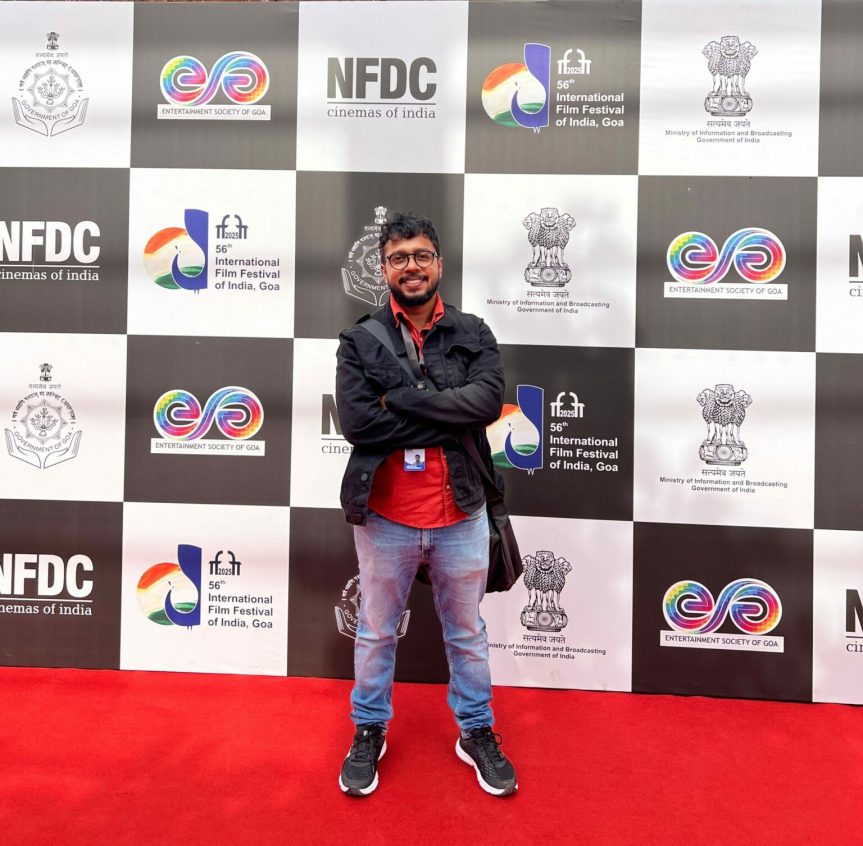
Govind holds a degree in Electrical and Electronics Engineering. In addition, he has obtained diplomas in Information Technology and Networking, as well as in filmmaking. He has been interested in photography since childhood. (Govind says that the camera his father bought for him right after he finished school helped shape his life.) Until 2011, he worked in an MNC in Bengaluru; later, recognizing the spark within himself, he shifted to his dream field in 2014.
During the COVID pandemic, he went to the United States and enrolled at the New York Film Academy, where he earned his MFA degree (2024). During that time, he did a Gold Rising internship from the Academy of Motion Picture Arts and Sciences, the organization behind the Oscars. Currently, he works as a Creative Producer at a company called Visual Narrative Films in Los Angeles.
Producing advertising films for corporates, music videos, and ad commercials are part of his professional work. But the work closest to his heart is making narrative films. So far, he has directed a few short films: ‘Framed, A Bedtime Story, The Maid, Khadima’, and worked in ‘Franky,’ ‘These Days’, and ‘The Invisible Force’ as Director of Photography.
The short film ‘Khadima’ is currently garnering attention at international film festivals. Govind plans to officially release it for the audience shortly.
Govind, who keeps flying between India and the United States to shoot films, dreams of reaching the position of one of the world’s finest film directors!
- (with the help of ChatGPT Translation)
$$$
 porulputhithu.com